Can you pass a color blind test?
Last Updated on May 26, 2018
This is the 3rd article in Color Theory: a complete set of lessons for Art students.
It is estimated that 40% of those who are colour blind remain undiagnosed by the time they get out loftier school. Could you be color blind? What does this even hateful? Are you entering a career where colour choices are important? What are the implications for an artist or designer who is colour blind – or for someone who is studying Art at school or college? How can designers ensure that their work is attainable for those with a vision deficiency? What modifications should be made when teaching a color blind student? Answers to these questions and more are discussed below.

This color system test (by Daniel Flück of Colblindor) is a version of the D-xv Farnsworth colour exam, which asks you arrange colors in a shine gradation of hues. You lot may wish to take this test and then return to the residue of this article.
I failed this examination. Am I color blind?
Firstly, please note that your monitor or digital screen may impact or invalidate results, as colors may not be represented exactly as intended. If the test indicates that y'all have some grade of colour deficiency, yous should seek out a full color vision diagnostic test from a physician to verify the results. This color bullheaded exam does not always identify those with mild colour blindness.
Please read on to discover general data nigh color blindess and what it may hateful for an artist or designer.
An overview of colour blindness for artists, students and teachers
What does color bullheaded hateful?
The following color blind definition is given by dictionary.com:
1. the inability to distinguish i or several chromatic colors, independent of the capacity for distinguishing light and shade.
2. complete inability to distinguish colors of the spectrum, with all objects appearing as shades of greyness, black, and white, varying but as to lightness and darkness.
This means that color incomprehension is the inability to see certain colors or to distinguish them from other colors. In rare cases, individuals may be unable to encounter any color at all and may view the world in blackness, white and grey.
What causes a deficiency in colour vision?
In people with normal vision, three types of cone cells exist in the eye, each sensitive to a dissimilar set of calorie-free wavelengths within the visible light spectrum: long, medium and short wavelengths. Although referred to as the 'blueish', 'green' and 'ruddy' cones, each receptor is sensitive to a range of wavelengths, and these are stimulated to a different degree, depending on the color of low-cal that is received. The different combinations issue in the perception of about a million distinguishable hues. When all of these three cone types are present, a person is able to perceive a continuous range of color, called trichromatic vision.
Color incomprehension occurs where an unusual combination of retinal cone cells are inherited, or where genetic mutation causes i or more of the cone types to be less sensitive than usual. For case, ii red or 2 green cones might be inherited along with bluish (rather than scarlet, light-green and blue cones that are normal). These variations may cause a mild or severe color vision deficiency.
Some people are born with abnormal red or green sensors. If they're somewhat abnormal, a person doesn't quite discriminate colors on the ruby-greenish cease of the spectrum too, but they may see them if they're bright." – Michael Marmor, a professor of ophthalmology at Stanford University
A rarer blazon of color blindness is acquired when a disease, infection or accident damages the middle, optic nervus or brain, resulting in a sudden or gradual onset of vision change. This blazon of color incomprehension is usually identified quickly, as the sufferer notices the change.
Tetrachromatic vision
A subset of women has been recently discovered to accept four types of cones (some hypothesise that these women might normally be the mothers of colour bullheaded sons), giving them tetrachromatic vision – the power to perceive an additional set of wavelengths that normal-vision people are unable to see. The additional cone normally picks upwards colors in the orange range (or sometimes other types of green) and may allow tetrachromatics to feel 100 million divide hues (99 million more than normal). This 'super vision' is only possible for women, equally the genes for paint in greenish and blood-red cones lie on the X chromosome. This super vision is estimated to occur in between two-three% of women, but, as with colour blindness, is often undiagnosed, as this always been 'normal' for them – having existed since nascence.
It may be impossible for us trichromats to imagine what a 4-colour world would look like. But mathematics alone suggests the difference would be phenomenal – Jay Neitz, color vision researcher at the Medical College of Wisconsin (Pittsburgh Post-Gazette)
How common is male color incomprehension?
About eight percent of the world'south men with Northern European ancestry are estimated to have color deficiency (one in 12 men). Information technology is common for high school classrooms to have at least one color blind student in the room, although this person may non always realise, or may hide this data from others.
Can women be color blind?
Women are far less likely to be color bullheaded – an estimated 0.4% of the female population. For a girl to be colour blind daughter, both her mother and male parent must acquit the factor.
How to test for color blindness
About colour blind tests ask you lot to identify an image, based on the Ishihara color test. Examination images are formed from dots of unlike colors that contain hidden pictures, messages or numbers. Some of the differences in hue are non discernible to those with certain types of vision deficiency.
An cheap colour blindness exam that can exist distributed to big groups and taken in less than five minutes is available from professors Jay Neitz and Maureen Neitz from the Department of Ophthalmology, University of Washington. This examination allows teachers to quietly and unobtrusively test all students for colour blindness in less than five minutes.
Tin can colour blindess be treated?
Color blind treatment does non yet exist, however professors Jay Neitz and Maureen Neitz are running exciting clinical trials in which gene therapy has been used to successfuly instate color vision in male monkeys that have been colour blind since nativity. They are still analysing long term side effects and whether the handling might 1 24-hour interval exist safe for humans.
There has besides been a recent invention of color blind correction spectacles. These allow some individuals to pass a color blind test, only do not provide an instant 'cure', every bit many might promise. In the words of London landscape painter Adam Fenton, who has cherry-red-dark-green color blindness and tested the glasses:
When I commencement heard about them, I envisioned wearing them and being instantly cured. It was nothing similar that, simply other interesting things happened. – from an commodity by Jeremy Hsu, Observe Magazine
The glasses help Adam to see warmer, redder hues, still sometimes made it difficult for him to dissever betwixt these warmer hues (for example, the divergence between blood-red and orange became more hard to run across) and too betwixt libation colors (greens, grays, blues).

What is information technology like to be color blind? How exercise colour bullheaded people encounter the globe?
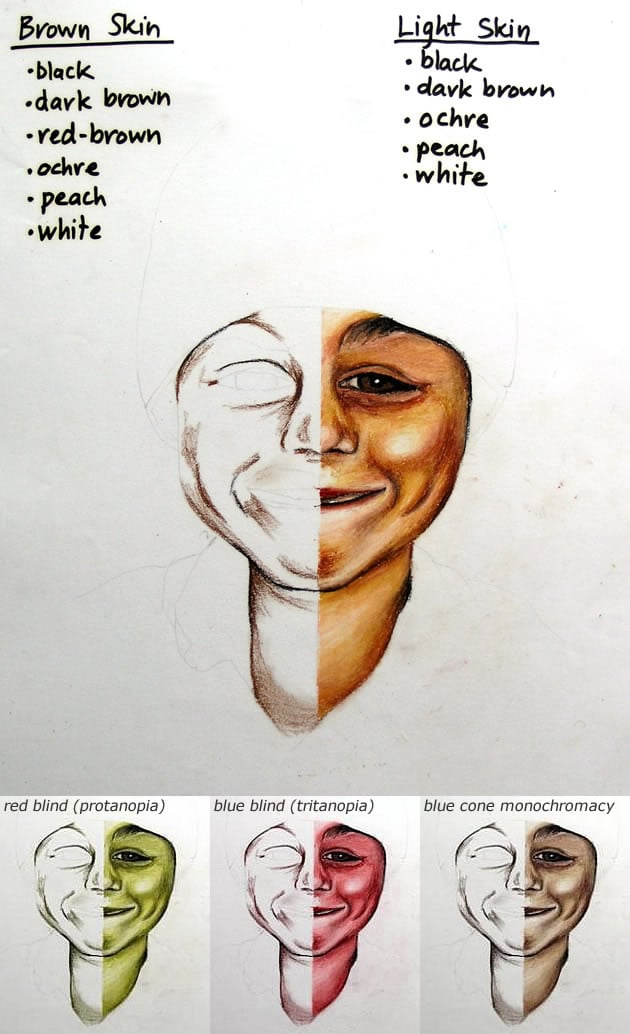
This depends upon the type of color incomprehension and the severity. According to the Usa National Library of Medicine, red-green color blindness is the most common type, followed by bluish-yellow color blindness (1/x,000 people) and lastly bluish cone monochromacy (1/100,000). It should be noted that these are broad titles that don't indicate clearly which colors are seen. Some people with a mild red-green color deficiency are able to differentiate between many shades of red and greenish, for instance. For more severe color blindness, however, whole groups of colors may look like darker and lighter versions of the same color (i.e. red, orangish and yellow may look like dissimilar tones of one hue).
According to colorvisiontesting.com the colors nigh oft confused are pinkish/gray, orange/red, white/green, greenish/dark-brown, blue dark-green/grayness, green/yellowish, dark-brown/maroon, and biscuit/dark-green.
Interestingly, Facebook is blue because Mark Zuckerberg is color blind –tweet this!
Colors don't thing much to Zuckerberg; a few years ago, he took an online test and realized that he was cerise-green color-blind. Blue is Facebook's dominant color, because, every bit he said, "bluish is the richest colour for me – I can see all of blueish." – Jose Antonio Vargas, The New Yorker
Almost people call back scarlet/green color bullheaded people confuse just red and light-green. This is not the instance at all – red/green color blind people have issues with colors right beyond the spectrum, especially reds, greens, oranges, browns and greys…[]…Dejection and purples tin can be confused because of the cerise tones in majestic and people with a reddish vision deficiency will find it hard to distinguish dark colors and can readily misfile a deep red with blackness! – colourblindawareness.org
I usually explain my color blindness similar this: "I don't encounter blood-red or green besides as most people. So if I'm looking at a purple that'south very blue, I might think it's blueish, since I don't pick up the red in it." Turns out that's the tip of the iceberg when it comes to oil painting. My teacher says I tend to make everything besides cold, that is, non cerise plenty. In a style, that makes sense–I don't run across the red in the model'southward peel, say, so I don't mix it into my paint on my pallet.
But in that location are also times where I make the opposite fault–I mix too crimson a color and get-go slathering it on. I suppose that makes sense likewise–I don't realize how cherry my mixture is–but there's something contradictory almost those mistakes, and I'm non sure how it happens. – anonymous colour blind artist
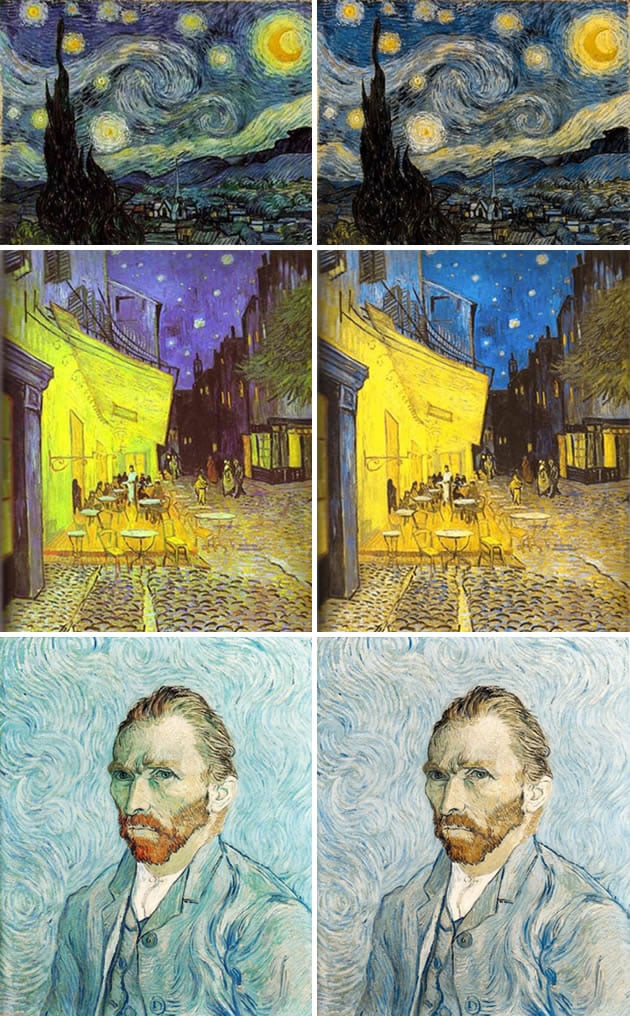
We have put together some illustrations beneath using digital color bullheaded simulators to aid illustrate what a colour bullheaded person sees. Digital simulators are are great tools for designers, as they allow you to test a blueprint and brand certain it is easy to navigate and read for those whose color vision is dumb.
These colour blind pictures take been produced using the free online simulator by Colblindor:


Yous might have heard the theory that Vincent van Gogh was color bullheaded – a question that was raised when a Japanese medical student Kazunori Asada noticed that the color palettes used in van Gogh's paintings appeared 'smoother' and more realistic when viewed through sure color bullheaded simulators (others are convinced that his competent handling of green makes this unlikely). Whether or non this is true or not, viewing artworks every bit others might see them is fascinating!
Color bullheaded students in the classroom – tips for teachers
Astringent color incomprehension can bring much frustration – mixing upwards crayons, missing color coded data, not recognising when fruit is ripe, not seeing the difference between red and green traffic lights and so on. It is of import for teachers to make lessons that minimise frustrations for those with diagnosed and undiagnosed color deficiencies. Many great points are outlined in the Teachers Advice Booklet for Secondary Schoolhouse prepared past www.colourblindawareness.org. We have summarised those that are relevant for Fine art students below, along with additional recommendations. Delight read their total document for more data and advice most other high school subjects.
- Ensure workspaces have brilliant, preferably natural lighting
- Underline fundamental words, rather than highlighting text with colors
- Consider guiding or limiting colour choices for the whole grade in certain tasks, specially at junior levels
- Include a range of projects that don't include color at all (black and white exercises, monochromatic sculpture etc)
- Ensure that some lessons accost other elements of art (line, shape, texture etc)
- Use descriptive names for colors, such as 'brilliant cherry' rather than 'vermillion' and label containers inside the classroom
- Proper name different colors to be used, equally in the instruction instance used for portraiture below (in this instance the teacher photocopied a student's drawing – after asking for volunteers – and demonstrated adding the different peel tones on the board, and so that students could follow along over the grade of the lesson). In instructor-directed exercises (such every bit might occur more frequently with younger students), give clear guidelines, if advisable, such as 'we will at present employ ochre to create an undercoat'…
- Use strong contrasting colors on whiteboards and digital screens – for example, blackness pen on a white board
- Exist on the alarm for any teasing regarding color choice or a failure to recognise colors. Remember that colour blind students may take a lot of anxiety about Fine art and worry about being taunted for color choices
- Be enlightened that many books, illustrations and graphic designs are non designed for a color blind audience and often contain portions that are inaccessible for those with a color vision deficiency. Photocopy sheets into black and white to check that all information is legible.
- When creating your ain resource, utilise the design guidelines below.
Designing for the color blind
Note: these recommendations often result in an comeback in clarity for those with normal color vision as well!
- Use patterns, shading or labels to differentiate items rather than (or in add-on to) color coding
- Use strong contrasting colors between text and groundwork, to improve legibility
- Test designs using a color blind simulator and in black and white to ensure that no data is lost
- Recollect that materials, viewing format and lighting weather condition affect how colors are recognized.
I am colour blind. Can I however exist an artist or designer?
At historic period 32, creative person Peter Milton, who had studied at Yale under Josef Albers, writer of Interaction of Colour, and was teaching Art at the Maryland Institute College of Art in Baltimore, received feedback that would forever alter the direction of his work.
…someone referred to how warm and sort of pinky the landscapes were," he says, "and I was horrified." – NPR.
A curt examination quickly diagnosed Peter with red-green color incomprehension. He at present works primarily in black and white, producing beautiful intricate prints.
Although a career in some areas of the visual arts may be challenging (if required to carry out precise color matching or mixing colours of paint, for example), the examples included within this article signal that beingness a color bullheaded creative person is entirely possible.
If you accept a confirmed colour deficiency, rather than concentrating on your inability to run into or mix every color, focus on the advantages of being color blind (yes, there are positives to exist found in every situation). Some colour blind people are better at detecting certain camouflages – and are able to perceive sure color combinations better than normal sighted people. Certain types of color deficiencies atomic number 82 to improved night vision and an ability to identify variations in luminosity with more accuracy (for case, a 'contrary color blind exam' has been created that many color blind people tin read, but normal visioned people cannot). Given the high proportions of red-green colour blindness, it is even suggested there may be an evolutionary advantage (perhaps men with this type of color blindness were ameliorate at spotting casualty – or an enemy – hiding in a woods)! Remember, likewise, that even those with 'normal' vision disagree about color choice.
The real – and perhaps surprising – advantage to colour blindness, still, is fabricated clear in the words of Soren Kierkegaard:
The more than nosotros limit ourselves, the more resourceful we get. – tweet this!
James Articulate explains:
Our limitations provide united states with the greatest opportunity for creativity and inventiveness.
Information technology tin exist easy to spend your life complaining virtually the opportunities that are withheld from us and the resource that nosotros need to brand our goals a reality.
Just there is an alternative. You tin can use your constraints to drive creativity.
This quote by an anonymous art educatee shows how initial daze at a diagnosis tin make way to credence:
I can't tell you enough of my shock when I found out I am color bullheaded. I wanted to be an artist since I was a child and the earth seemed shattered when I learned nearly that. But, look at it from the bright side, if y'all didn't know about your color vision trouble until you took a exam, that means your problem isn't also severe. That likewise ways color theory is your best friend.
In an e-mail to Fotis Flevotomos, Michael Marmor, professor and past chair of ophthalmology at the Stanford University School of Medicine, makes this splendid betoken:
I try to teach students that low vision or color "blindness" are non necessarily faulty vision… they are "unlike" vision. And may in some ways be better, or at least merely equally valid, depending on what you lot are trying to do. You lot have more of an "impressionist" view of a distant landscape than others with perfect vision — it's not better or worse, merely culling.
Jessica Helfand, senior critic in graphic design at Yale School of Art and lecturer in Yale College, talks well-nigh a color bullheaded student who enrolled in her course Bluish: the cultural and iconic history of blue as both a method and a motive for making work in the studio:
My colour-bullheaded student was brave enough to take this course and he has excelled here, precisely because he is willing to push himself, to ask questions, to endeavor new and unusual things each week. – YaleNews
And in the words of Edgar Degas, quoted in NPR:
I am convinced that these differences in vision are of no importance. I sees every bit ane wishes to encounter. It's false, and it is that falsity that constitutes fine art.
Art teacher Ronda Sternhagen likewise made this bully annotate on an article on The Art of Didactics:
Whenever I have a student similar this, we more often than not dive into a chat nigh who is right? Possibly "we" are color blind and this student sees the colors in the "correct" way. It sort of boosts them up and makes them feel similar it actually isn't that big of a deal…information technology's who they are, they have (or will accept) learned to adapt, and we go about our concern of being artists. Isn't that what makes art special? We all have our own solutions to the "problems."
So what does it mean to be color blind in an artistic career? It means you have an additional design constraint – one that may, in fact, grade a cracking betoken of deviation and trigger creative output. Perhaps you can brand fine art about color blindness itself and throw yourself full throttle into an investigation of colour, as yous come across information technology. Possibly you can proceed as you have washed, but seek exterior input for color choices (such as the opinion of others or using digital color matching tools) or intellectualize some aspects of color theory. Perhaps you deliberately move away from realism and apply unusual, unexpected colour schemes with purpose, or limit your color palette to those you lot encounter well. Mayhap y'all embrace your own unlike view of color and celebrate information technology. Perhaps you lot focus on the many other wonderful and critical aspects of an artwork – line, texture, shape, space, tone, 3D form, surface or material (in case information technology isn't obvious, a color blind creative person can still be an exceptional observational drawer; a phenomenal sculptor; generate inventive compositions and communicate ideas visually in superb, original means).
I am a color blind creative person. I teach effectually the Us on graphics (and have produced some Photoshop tutorial videos) and am a designer for my ain company. My partners assist me out many times when I get confused by color (though I notwithstanding create pretty much all the dazzling graphics and designs for our firm as my 'perspective' is often times so different that our clients love it) – a quote from Vischeck.com
In his first-class book Art & Ophthalmology: The Bear on of Heart Diseases on Painters Phillippe Lanthony makes the observation that while color blind painters may use a limited colour palette, their work is 'not at all discernible from those paintings that are made past a painter with normal color vision' and that color bullheaded painters are thus difficult to detect throughout history.
To requite you further example of what is possible, nosotros have collated a list of some more famous colour blind people who have achieved success in the art and blueprint field.
A list of colour bullheaded artists
- Color blind artist Neil Harbisson has achromatopsia, which means he sees no colour at all. He wears a custom made high-tech headset that measures color frequency and transmits this into a sound that is transmitted straight into his skull via a headband. Rather than seeing colour, he hears it.
Harbisson got into art school, subsequently teachers fabricated an exception, letting him pigment just in the gray scale. He went on to study color theory.
Harbisson said if someone institute a cure for his color-blindness, he'due south not certain he'd take it. He said he thinks processing and then much new information could be overwhelming, and his quest to understand color would somehow lose its spiritual quality. – Gerry Hadden, PRI
- Charles Méryon gradually gave up painting to go a black and white printmaker later he was diagnosed with red–dark-green color incomprehension. He is i of the most significant etchers of 19th Century French republic.
- Colour bullheaded painter Clifton Ernest Pugh was awarded the Commonwealth of australia'due south Archibald Prize three times and recognized for his contribution to Australian art.
- Irish painter Paul Henry concealed his color blindness and it was only revealed by his md after his death. In the afterwards part of his career, he chose to paint predominantly in dejection and yellows.
- Australian colour blind artist James Charles Nuttall studied at the National Gallery School of Design and then worked as an illustrator. Copies of his near famous work, a monochromatic sepia painting titled 'The Kickoff Federal Parliament of Australia, May 1901' were hung in homes and schools throughout Australia.
- Artist Robert McCall who produces spaceflight-themed piece of work, discovered that he was colour bullheaded when he was xx. He had been making a living as an artist for the previous iii years and the possibility that he was color blind had never occurred to him.
- Royce Deans studied at the American Academy of Art in Chicago, majoring in illustration and design. His paintings have hung on the walls of McDonalds restaurants throughout the world. This quote is from an interview with Artist Perspectives:
My "hue challenged" situation has affected my mode, and probably even more so my method. For years I frustrated myself trying to do things right. Then, three years agone I had a sort of a rebirth experience. …[]… My preliminary drawings had heavy blackness lines in them and they made me think of stained glass windows. And then I started filling in the spaces in and around the figures with the brightest colors I could find. Most were right straight out of the tubes. I was completely intoxicated. – Royce Deans
- Albert Uderzo, ane of the creators of the world renowned Astérix comic book series is color blind and carefully labelled his pens as a boy.
- Comic book artist Tim Auction provides the artwork for the Goggle box shoe heroes. He is color blind and creates works in black and white that are digitally colored past others.
- Another comic volume creator John Lindley Byrne is unable to see some greens and browns. He has worked on Marvel Comics, X-Men and Fantastic Iv.
- When colored pencil artist Bonnie Auten found out she was color bullheaded, she learned everything she could about color theory, the color wheel and colour blindness.
I am atypical in that I do not meet everything in vivid colors. Since I am color blind, or colour recessive, colors are visible to me, but not all their gradations. I used to think this was an bloodcurdling handicap, however, I now believe it makes my art unique. My work features value, course and limerick more dominantly than color. – Bonnie Auten
Let's end with this reminder:


Amiria has been an Art & Design instructor and a Curriculum Co-ordinator for seven years, responsible for the course design and assessment of student work in two high-achieving Auckland schools. She has a Bachelor of Architectural Studies, Bachelor of Compages (Start Class Honours) and a Graduate Diploma of Didactics. Amiria is a CIE Accredited Fine art & Design Coursework Assessor.
Source: https://www.studentartguide.com/articles/color-blind-test

Post a Comment for "Can you pass a color blind test?"